One of my books ventured into the future and spoke of pandemics. It was published in 2014. In my story, I called the first pandemic 'Pan 1.' I had it starting in 2023, but in my book, it took the young as well as the old, and its death toll was far higher. What I imagined was more serious than Covid-19.
But 'Then came the next pandemic. This one was different. This one killed the healthy as well as the old and sick. This time, action was very quick, reducing the spread. Areas were quarantined, borders closed, international trade and travel ceased. The hardest hit were places that were over-crowded and with poor hygiene. It did mean that the last of the wars stopped - members of armies were either dead or had fled.'
'School and university buildings were empty. People studied now online or not at all. No-one knew how long that would last. Some drugs once deemed essential were no longer available. Some suffered because of it, others found, to their surprise, that their health improved. The import of illegal drugs had ceased, but as few addicts had survived the first pandemic, there was little demand. Law and order was maintained, in some areas, even improved.'
Australia has done very well so far, only 63 deaths as at 17th April, 2020, but while the virus exists, and while there is neither cure nor vaccine, the relative good fortune cannot last forever.
In my story, there were four pandemics, each a variety of flu, each slightly different. There was never time to develop a vaccine. The population of Australia went down to around 12 million, even though Australia was less affected than most countries. The world's population went down to not much over two billion. 'It was an estimate. There was no census.'

I predicted that there would be a shortage of fuel and that this would happen quite quickly. So for transport, people turned back to horses, and old and historical steam trains were brought back into use, sometimes using the timber from abandoned houses to fuel the fires.

I predicted a flight from the cities, and a transformation of rural areas. Sydney's population is currently a bit under five million residents. In my story, it dropped to 200,000. There were whole suburbs with only empty houses, though some were being razed in order to grow crops and sustain livestock, especially horses.
Country areas were doing better. For instance, in country NSW, there is a tiny place called 'Leadville.' There are only a few houses still occupied in Leadville, no shops, no hotel or restaurant, no school. It seems dead. Leadville. Even the name sounds dead.
But after the series of pandemics, things were different, and Leadville has become a thriving little town.
A major character in my book is Shuki's niece, Meriam. She is now a TV presenter, doing a series of shows on the way that things had changed since the pandemics. This show centres on Leadville.
'It started the same way as it had the previous week, a picture of Meriam alone in the carriage of a train. She wore a face-mask; everyone wore a face-mask when on public transport. The train ran on steam, though diesel trains were beginning to make a comeback. Australia was now supplying its own fuel needs. A network of rail criss-crossed the country, most of it new. It carried essential supplies, but few passengers. There was no freight on the roads, and people needed a permit to travel out of their own district.
The viewpoint widened to show the countryside the train ran through. The crops and apparent prosperity belied the shortages that had caused a great deal of hardship. But almost everything that had been imported was now either made or grown in Australia, replaced with an alternative, or simply, people managed without. There were still minor outbreaks of disease, but they were treated as emergencies and very quickly contained. Australia had not experienced anything significant for the past two years. It was hoped that the bad times were over.'
 I predicted that production would become far more localised. It has never made sense that simple items should be sent across the world. The immediate shortages now, with this relatively minor pandemic, reinforce the foolishness of this. In my story, I had market gardens on the outskirts of the town, as well as small factories and warehouses to
serve the needs of the immediate area.
Meriam spoke of crops that sustained the population of Leadville - corn, wheat, canola, sorghum.
Obviously, it is too soon to say how many of my predictions have been accurate, and for us, in April, 2020, it is likely that things will soon be back to normal - at least until there is a far more serious pandemic.
Communications -
In my story, I said that most homes had a 'communications room' as well as the public one in every town and village. 'Internet connections were routinely excellent. It was a necessity. Schooling and meetings were invariably by internet unless unavoidable, for example, practical training.'
And right now, April, 2020, most teaching is now online, and so are meetings. I was correct in that prediction, but that was an easy one.
I predicted that imports and exports would largely cease, and that production would shift to more localised production.
This is happening, but only to a limited extent. There are still shortages of some essentials, even though it would appear those items should be very easy to make locally. There is a lot of talk of ensuring that our supply lines should not be so easily broken next time, and there is talk that we should absolutely definitely, NOT be so dependent on imports from China, China where the pandemic originated.
But this is not a severe pandemic, and I expect that this resolve will be forgotten quite soon.
The handshake - My prediction was that no-one would shake hands any more. 'He held his clasped hands forward in the gesture that had taken the place of a handshake.'
 We are yet to see what gesture will replace the handshake in the long term, but I like my idea better than the silly looking elbow bump, usually performed to the accompaniment of embarrassed smirks.
And besides, it is only suitable if people are physically close, and these days, we are 'social distancing.'
My predictions for life after the pandemics?
According to Meriam - "We've survived the sad years, the Pan years. We've survived Pans 1, 2, 3 and 4. With the quarantine provisions and the closed borders, we will survive if there is a Pan 5.'
In my story, Meriam's daughter was called Laleh. She was watching her mother on TV. But then afterwards...
But some years later, Meriam was on TV again, another special. There had been no further pandemics, and this time, she speaks of the progress that was being made all over the world. Borders are still closed to non-essential travel, but some international trade is being re-established and some people were being permitted to rejoin their families when they'd been separated by the abrupt closure of borders.
I named that book 'The Frost and the Sunshine.' There is a theme running through it, that bad times happen, 'the Frost,' but then the sun comes shining though, and the good times return.
And a slightly later excerpt -
'School and university buildings were empty. People studied now online or not at all. No-one knew how long that would last. Some drugs once deemed essential were no longer available. Some suffered because of it, others found, to their surprise, that their health improved. The import of illegal drugs had ceased, but as few addicts had survived the first pandemic, there was little demand. Law and order was maintained, in some areas, even improved.'
Australia has done very well so far, only 63 deaths as at 17th April, 2020, but while the virus exists, and while there is neither cure nor vaccine, the relative good fortune cannot last forever.

I predicted that there would be a shortage of fuel and that this would happen quite quickly. So for transport, people turned back to horses, and old and historical steam trains were brought back into use, sometimes using the timber from abandoned houses to fuel the fires.

I predicted a flight from the cities, and a transformation of rural areas. Sydney's population is currently a bit under five million residents. In my story, it dropped to 200,000. There were whole suburbs with only empty houses, though some were being razed in order to grow crops and sustain livestock, especially horses.
Country areas were doing better. For instance, in country NSW, there is a tiny place called 'Leadville.' There are only a few houses still occupied in Leadville, no shops, no hotel or restaurant, no school. It seems dead. Leadville. Even the name sounds dead.
A major character in my book is Shuki's niece, Meriam. She is now a TV presenter, doing a series of shows on the way that things had changed since the pandemics. This show centres on Leadville.
'It started the same way as it had the previous week, a picture of Meriam alone in the carriage of a train. She wore a face-mask; everyone wore a face-mask when on public transport. The train ran on steam, though diesel trains were beginning to make a comeback. Australia was now supplying its own fuel needs. A network of rail criss-crossed the country, most of it new. It carried essential supplies, but few passengers. There was no freight on the roads, and people needed a permit to travel out of their own district.
The viewpoint widened to show the countryside the train ran through. The crops and apparent prosperity belied the shortages that had caused a great deal of hardship. But almost everything that had been imported was now either made or grown in Australia, replaced with an alternative, or simply, people managed without. There were still minor outbreaks of disease, but they were treated as emergencies and very quickly contained. Australia had not experienced anything significant for the past two years. It was hoped that the bad times were over.'
 I predicted that production would become far more localised. It has never made sense that simple items should be sent across the world. The immediate shortages now, with this relatively minor pandemic, reinforce the foolishness of this. In my story, I had market gardens on the outskirts of the town, as well as small factories and warehouses to
serve the needs of the immediate area.
"And grapes for wine. Grapes grow well here, though they say - sadly - that they've not yet perfected the art of beer-making. They're working on it."
When every import is a risk, there would not be much coming in that is not essential.
Meriam again - "No fish and chips, of course. Fish would have to be brought in. Plenty of fried chicken though, if that's your fancy. And potatoes are easily available, so naturally, you can have chips - with anything you like. Leadville has an excellent variety of produce," and she laughed, "Not caviar."
There were more snippets in my book. Shuki goes by train to Sydney, though even the station master is surprised that he is making the trip. 'You're a bit rash going to Sydney, aren't you?' There are no physical tickets, and the station master is behind impermeable glass.
And the routine instructions - "Hand sanitiser before boarding and available in each compartment. Avoid touching anything you don't need to. Seat covers are changed after every trip, and surfaces washed down, but you can't be too careful."
Conditions on the train - 'There was no heating, no air conditioning, and Shuki remarked that he couldn't complain, as he was the one who'd said that they could no longer afford to risk the transmission of infection through air conditioning systems. They were alone in their compartment, and only caught a brief glimpse of another passenger who boarded at Leverson. He'd be alone in his own small compartment. There was only one passenger carriage, though several freight carriages that would be taking country produce to the city. There were still two hundred thousand Sydney residents, a tiny fraction of its former population.'
The hotel in Sydney:
Their hotel was stark, with no unnecessary furnishings or decoration. 'Very expensive, but there was heating - self-contained in each room. The rooms would be scrubbed and fumigated on their departure. There was no such thing as a cheap hotel any more - the regulations made it too difficult.'
-----------
Obviously, it is too soon to say how many of my predictions have been accurate, and for us, in April, 2020, it is likely that things will soon be back to normal - at least until there is a far more serious pandemic.
Communications -
In my story, I said that most homes had a 'communications room' as well as the public one in every town and village. 'Internet connections were routinely excellent. It was a necessity. Schooling and meetings were invariably by internet unless unavoidable, for example, practical training.'
And right now, April, 2020, most teaching is now online, and so are meetings. I was correct in that prediction, but that was an easy one.
I predicted that imports and exports would largely cease, and that production would shift to more localised production.
This is happening, but only to a limited extent. There are still shortages of some essentials, even though it would appear those items should be very easy to make locally. There is a lot of talk of ensuring that our supply lines should not be so easily broken next time, and there is talk that we should absolutely definitely, NOT be so dependent on imports from China, China where the pandemic originated.
But this is not a severe pandemic, and I expect that this resolve will be forgotten quite soon.
The handshake - My prediction was that no-one would shake hands any more. 'He held his clasped hands forward in the gesture that had taken the place of a handshake.'
 We are yet to see what gesture will replace the handshake in the long term, but I like my idea better than the silly looking elbow bump, usually performed to the accompaniment of embarrassed smirks.
And besides, it is only suitable if people are physically close, and these days, we are 'social distancing.'
My predictions for life after the pandemics?
According to Meriam - "We've survived the sad years, the Pan years. We've survived Pans 1, 2, 3 and 4. With the quarantine provisions and the closed borders, we will survive if there is a Pan 5.'
In my story, Meriam's daughter was called Laleh. She was watching her mother on TV. But then afterwards...
'Laleh sighed and turned the screen to her schoolwork. Things may have improved, but there were drawbacks. No-one could have a lot of children for instance. There were no actual laws against it, but even the new young pope said there should only be two children for each couple, that the world must never again become so over-crowded that contagious disease was so difficult to contain. The biggest regret for her was that it was so difficult to meet people. She was in her teens. A generation ago, she would have been actively socialising, and within a few years, the socialising would have been with marriage in mind. There had been few marriages made ever since Pan 2, and almost no babies. People were waiting. Laleh was an attractive young woman of eighteen. She'd never been kissed.'
But some years later, Meriam was on TV again, another special. There had been no further pandemics, and this time, she speaks of the progress that was being made all over the world. Borders are still closed to non-essential travel, but some international trade is being re-established and some people were being permitted to rejoin their families when they'd been separated by the abrupt closure of borders.
Meriam said, "It will be a while before large gatherings such as rock concerts or festivals are permitted, but one day, we will enjoy that again. One day, we will enjoy travel again, even travel overseas.
"And now I want to show you something very special." She turned and the camera view widened to show Zahu holding a tiny baby. He came to her side and Meriam continued, "We waited, all of us, afraid to have children, afraid to trust in a future."
The camera zoomed in on the baby, and Meriam's voice softened. "This is Ben, our baby. We made the decision, my husband and I, that it was time to trust in our future. We had a baby. It is the best thing I ever did. I think all of us should now trust in our future. We need a new generation of children. My uncle, Shuki Bolkiah, told the world that each couple should only have one or two children. He was right. But now, now it is time.'
In the next year, there were many babies. People had been waiting, but now it was time.
I named that book 'The Frost and the Sunshine.' There is a theme running through it, that bad times happen, 'the Frost,' but then the sun comes shining though, and the good times return.
 |
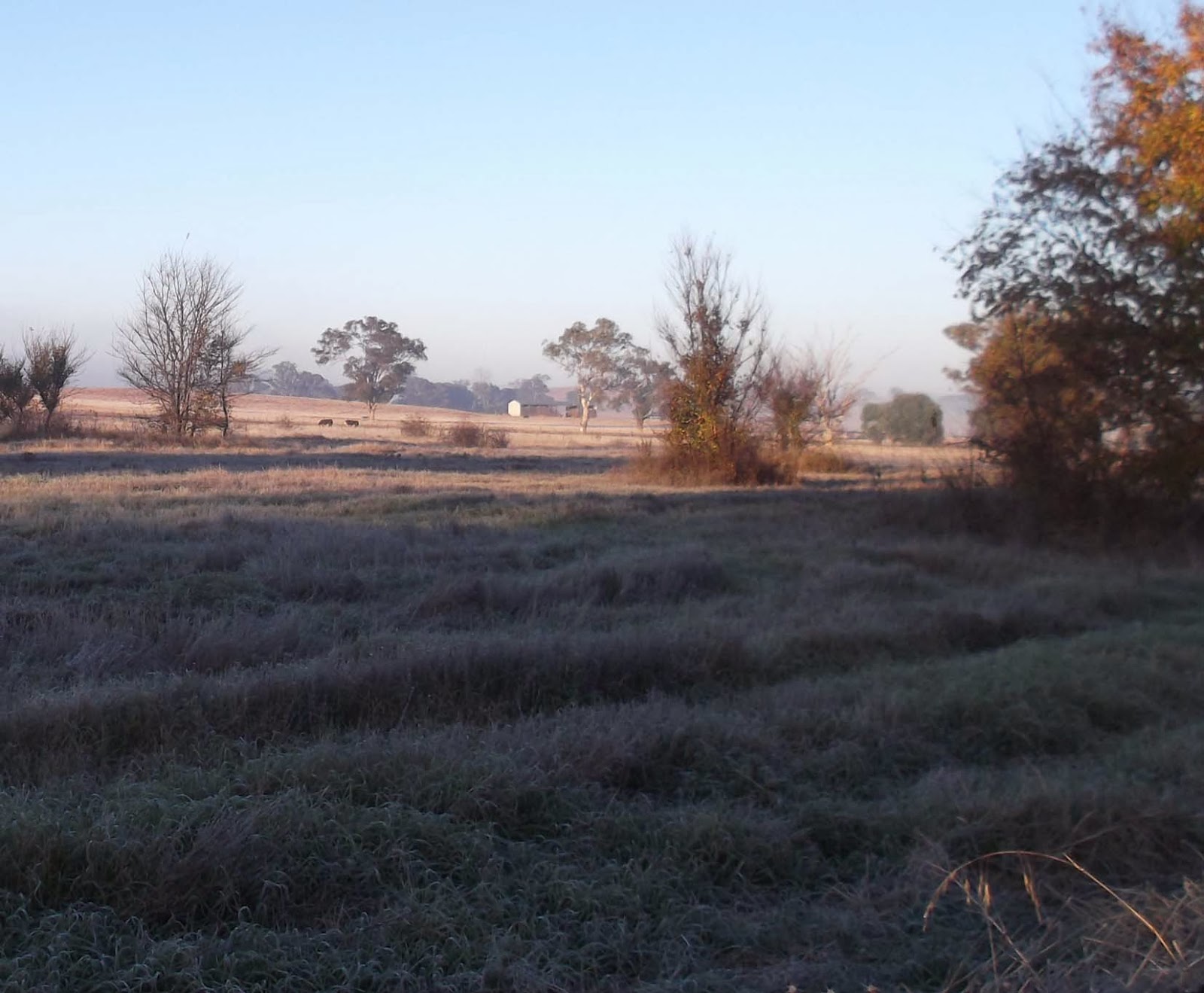
| Cold and frosty morning in Gulgong, NSW |
'And yet, in spite of the continuing catastrophe, except for some third world countries, infrastructure and government remained intact and communication online or by telephone was quick and easy.
The world had changed. It had not ended.'
And this is direct from my book. 'He (Shuki) wondered sometimes - Pan 1 had been cruel, but if there hadn't been that warning, if the more severe second pandemic had come first, would civilisation have survived? People lived differently these days. Other infectious diseases could not spread, and even the normal coughs and colds that had been taken for granted, no longer happened.'
Our current pandemic, Covid-19, has a very low death rate compared to the 'Pan 1' in my story. But there will be good things come out of it - a greater self reliance, a greater preparedness.

When more pandemics follow this one, the lessons of early closures of borders, of hygiene and 'social distancing,' and of being able to source essential supplies from within our own borders - these will all be important.
Humankind will prevail, in spite of nasty bugs. There will be victory, as there has been before when we are faced with powerful enemies.
But some of us should keep a diary. Whether or not the death rate of Covid-19 is low or high, our whole world has been changed. These days are significant days.


To buy any of my books, go to Smashwords, or The Book Depository or Amazon or any other online bookseller. Look for M. A. McRae. The Shuki series starts with 'Not a Man,' and concludes with 'The Frost and the Sunshine.' Each can be read as a standalone.
--------------------------