Showing posts with label Victoria. Show all posts

Friday, 7 December 2018

The Silo Art Trail


The Mallee area of Victoria is mostly flat country, hot and dry, boring to look at, and often too hot for any comfort.   All the same, it is productive country and grows a big percentage of Australia's grain crop most years. (Not counting drought years.)

Mallee, Victoria, Australia

The Mallee is dotted by tiny towns, towns that have been declining in population ever since horses were replaced by tractors.

It is not an area that lures tourists.  Some towns have simply died, others linger on.  There are abandoned houses, abandoned churches.


Many churches these days appear to need propping up.

Few need actual timber supports, however! 


There are derelict buildings, even in main streets.  This is Rupanyup.
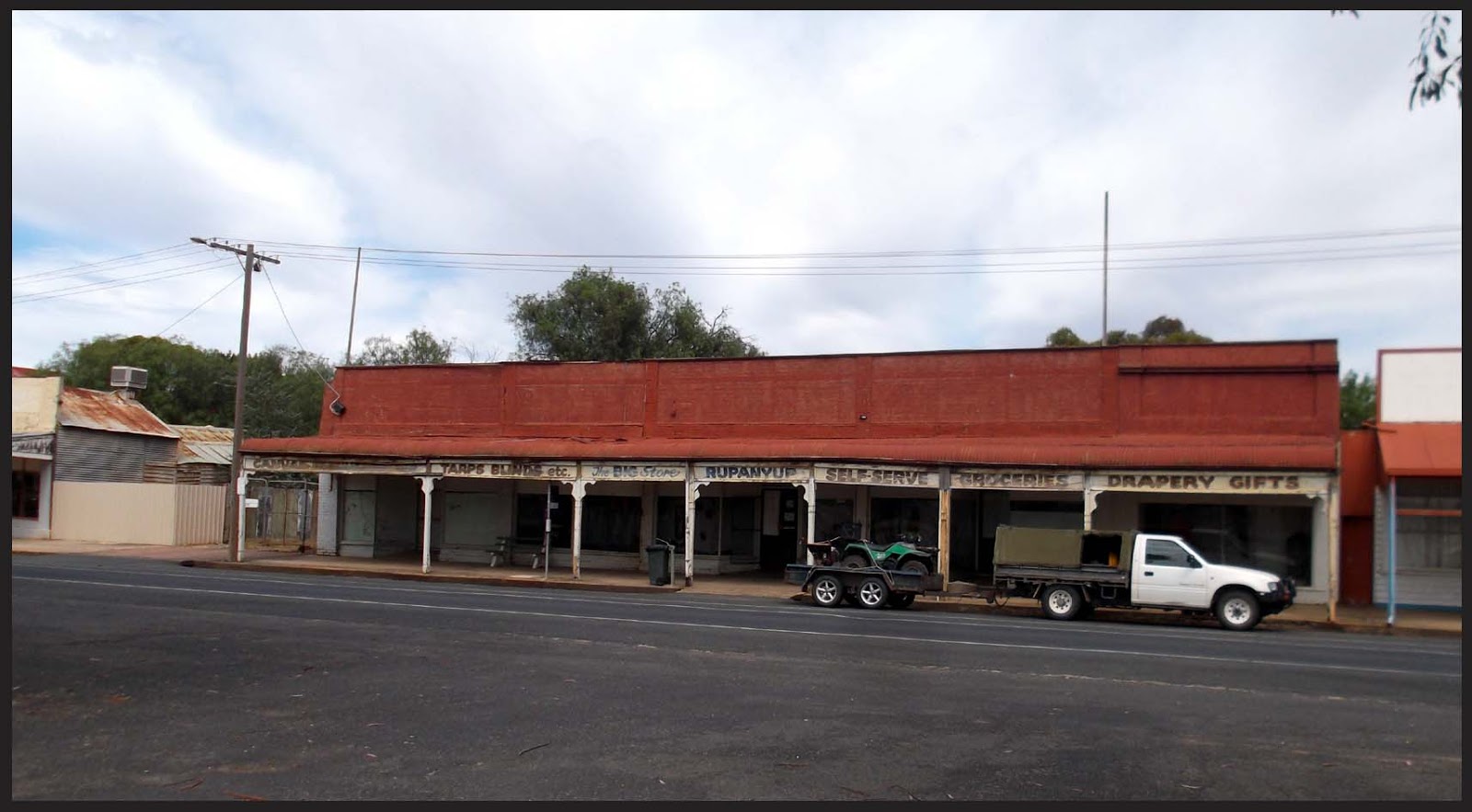


But then there is this gorgeous little building in the centre of the street. That is also Rupanyup.


There is this abandoned home in Patchewollock.


But there is also this joyous piece of art, also in Patchewollock.


The towns might have become rundown, but the people are still full of life, and they want life back in their towns. One way is to attract tourists.  The Silo Art Trail is a genius idea, and it is successful. In caravan parks a long way from the Mallee, I heard talk of it, and many had either just been, or planned to go.  These are mostly the 'Grey Nomad' travellers, who are happy to have a plan for their explorations, and who have money to spend.

In every small town and tiny village of the Mallee, there is a silo.  When these become paintings, they are very, very impressive.


These are tourists at Sheep Hills.

Sheep Hills was the tiniest town we saw, just a few abandoned buildings, and a pub that must have been nice once.  It did not appear to be in use.


And yet, Sheep Hills has this.


I included the people to give some idea of the scale, even though they are closer to the camera.


Below is at Rapunyup.  These silos are not as tall as most, and yet you can see the vehicle parked close.  Those pictures are big! 


The several councils involved have gone to some effort. There are brochures, there are signs, and some of the towns even appear to have put in brand-new and immaculately clean toilets - a thing of importance for travellers.


Six towns (if you can call Sheep Hills a town) with painted silos.  Other towns with street art and open air sculptures.  They are all deserving of a visit.  


The Mallee Fowl sculptures (left)  are at Patchewollock.

Just a couple of years ago, we visited Minyip.  We were saddened to see it so rundown.  But now, there are new shops opened, and everything seems to have been cleaned up.  While Minyip does not have its own silo art, it is a pleasant place to visit, and does have some street art to admire. 


Brim's silo paintings (above)  were the first.  I think they are the best of all, 
though the photograph above does not show the figures to full effect
due to the sun being directly behind them. 


The visionary councils of the Mallee Silo Art Trail deserve credit.  They have brought life back to their portion of the world, and they have given travellers something marvellous to look at.

They deserve support,  so next time you are in Victoria, make a trip to the Mallee to enjoy the silos.  Just follow the green-marked route.   (But not in the middle of Summer.  It can get very hot there.) 


Wednesday, 17 September 2014

Post WW2 Soldier Settlement in Australia.


Soldier Settlement schemes in Australia, otherwise known as   Closer Settlement Schemes

 This book is a part of our history.  It is why it has been re-published.  Look for it at any online bookseller.


The original edition of 'On The Block'
was published by Merv McRae, 1987,
with proceeds being donated to Legacy.
It is now out of print.
 
 Publisher: The Sunnyland Press, Red Cliffs, Victoria.
National Library of Australia,  ISBN 0 7316 01327.


This is the new edition of the book. Some pictures have been reproduced, especially the maps of the estates that were divided for settlement, but the original photographs are no longer available. 


In the words of Merv McRae, the one who put this history together: 
The purpose of this book is to record the early memories of Soldier Settlement, and the good and not so good times we had. With this in view, who better to do it than the people who lived it?

Mortlake Shire has many soldier settlers, this book covers those in the Darlington area. I think the majority of the settlers were in a similar position to myself.

After getting out of the army in 1945-46 we were left to our own devices and were a bit lost. That was when the settlement scheme came into being. It gave us some direction, and we were ready and willing to take up the challenge. I think we would all vote it a resounding success, although you will see by this book it was no pushover. The women worked beside their men, and we felt a bit like pioneers. We were given a living allowance, until we had an income; after all we had to eat. Many of us milked cows to survive, nearly all the trees you see now on the soldier settlement were planted by the settlers, as well as the improved pastures; there was very little improved pasture on the earlier settlements.


These are the areas covered:


Mt. Fyans,
Stokies,
Terrinallum,
Barnie Bolac,
Jellalabad,
Myrngrong,
Geddes',
Morrison's,
Terrinallum West Estates
North Station.


These are the people who contributed to this book:


Austin, T.   Badham, Greta.   Badham, R.   Banks, J. & M.   Biggin, B.   Biggin, Marj.   Biggin, Rob.   Blain, Mick.   Blain, Marg. (nee Reichman.)   Brewer, Doris.   Buntine, L. & E.   Burgess, T.   Chambers, J.   Cumming, E. & L.   Creen, Ethel.   Edmunds, J.   Erwin, J.   George, D. (nee Watson)   Gill, Lena.   Gladman, Joyce.   Gleeson, W. & P.   Gleghorn, Mary.   Grant, L. & M.   Gray, B. & J.   Gray, D. & Y.   Gray, R. & P.   Grills, L.& L.   Guthrie, L. M.   Hamilton, A. & J.   Hannah, J.   Harding, Jean.   Harrison, J. & E.   Hebbard, E. & M.   Hill, Iris.   Inglis, Louise (nee McRae)   Jackson, Joanne.   Kennedy, F.   Kidman, J. & J.   Krepp, G. & A.   Lade, D. L. & W. L.   Lade, M.   Lawson, Pauline, (nee Piper)   Lavery, J.   Luckock, Jean.   Lyon, W. P.   Lyon, Molly.   Maconachie, G. R.   Menzies, J.   Monds, A. & M.   Moroney, Iris.   McRae, A. M.   McRae, M. A.   Muir, Freda.   Murray, G. & N.   Price, J.   Proctor, G. & M.   Rogash, Lorna.   Robertson, J.   Ritchie, N.   Schafer, A. & M.   Scott, T. & M.   Sullivan, Bonnie (now Kennedy)   Tonkin, A.   Turner, Elsie, (now Christie)   Walker, A. K. & L. J.   Wentworth, M. & I.   Wentworth, J. And Nance,   Whelan, Gary.   Williams (nee Rogash.)


The Western plains of Victoria are flat and almost featureless.  There are plantations (planted, not natural vegetation)  and the occasional small volcano rising its head from the flat landscape.


IN RETROSPECT....

Memory is selective; it tends to veil the bad times in a merciful mist, but depicts the good times in exaggerated glowing colours.
 

How did we cope in those early years
In a bare little hut with a baby son?
With a lot of laughs, and not many tears,
For we were young, and it seemed like fun!
And we shared with neighbours our hopes and fears,
And the many urgent jobs to be done.

We had no road, no phone, no power.
Money was scarce, and water was too.
But we filled kero. tins from each passing shower,
And lived very cheaply on rabbit stew.
And we made the most of each precious hour,
And worked like beavers the long day through.

Then the road went through, and our house was complete.
The mail-man and school-bus came to our gate.
The phone was connected and, that was a treat.
The power was switched on, and wasn’t it great?
We felt like lords in our country seat,
And sheep replaced rabbits upon our estate.


                     Poem by Alison McRae


FOR THOSE INTERESTED IN THIS HISTORY:

Maps of the estates as they were divided for closer settlement. I have reproduced them as big as the 'blog' setup allows. There may be researchers interested. The original documents may be available elsewhere, of course.


There was one measure of success that the scheme fulfilled very successfully - it provided a horde of Baby Boomer children with a great childhood.

Plucking chooks at the sawbench.
Typical Soldier Settlement house in background


Enjoying a bonfire.